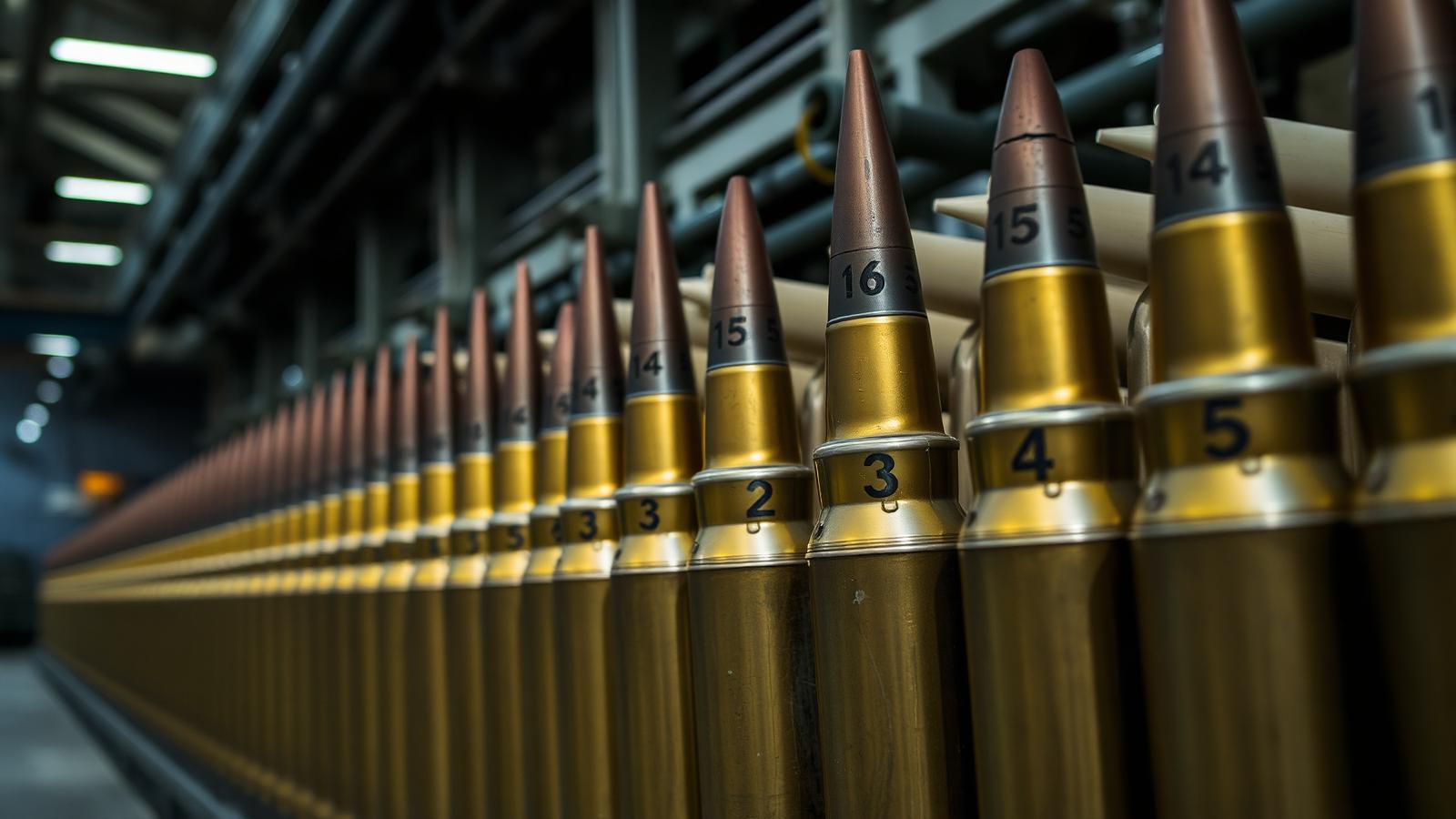
The arithmetic of a 155mm round: from cotton field to artillery shell
European propellant capacity does not scale linearly with shell capacity. Anyone proposing to fund the latter without budgeting for the former is asking the bank to lend against an assumption that has already failed once.
The European 155mm production target is conventionally discussed in shells. NATO and the EU collectively want roughly 1.7 million rounds per year, sustained through 2030. The arithmetic that converts this number into a raw-material requirement is fixed by chemistry, agronomy, and processing yields. It is unglamorous, but it determines whether the announced capacity is real or aspirational. The remainder of this note works through it.
Step one: propellant per round
A 155mm L52 round carries between 9 and 13 kilograms of propellant, depending on charge type and configuration. The standard modular charge family used by NATO 155mm artillery falls inside that range. For a planning average, a round of mixed configuration consumes approximately 10 kilograms of propellant. At 1.7 million rounds per year, that is 17,000 tonnes of propellant.
Step two: nitrocellulose per tonne of propellant
Modern artillery propellants are nitrocellulose-based, either single-base (nitrocellulose only) or double-base (nitrocellulose plus nitroglycerin). Across the propellant types in current European production, the nitrocellulose content runs roughly 75 to 95 per cent by mass. Using a midpoint value of 87 per cent for planning, 17,000 tonnes of propellant requires approximately 14,800 tonnes of nitrocellulose.
Step three: linters per tonne of nitrocellulose
Nitrocellulose is produced by nitrating cellulose. The cellulose feedstock for defence-grade nitrocellulose is second-cut cotton linters. Industrial yields run close to 1:1 by mass, with small losses; a tonne of second-cut linters yields roughly one tonne of nitrocellulose. The annual European requirement is therefore close to 14,700 tonnes of defence-grade linters.
The interchangeable use of wood pulp has been discussed since the 1970s. It has not closed the specification gap for defence-grade nitrocellulose at the scale European producers operate. The supply chain has to assume linters.
Step four: cotton per tonne of linters
This is where the arithmetic stops being intuitive. A cotton plant produces approximately three things in commercially useful quantities: lint (the fibre destined for textiles), cottonseed, and linters. Linters are the short fibres still attached to the seed after the first cut of lint has been removed. They come off in two passes at the gin: first-cut linters, which are coarser and used for paper and chemical applications, and second-cut linters, which are short, pure cellulose and the only grade defence nitrocellulose can use.
The yield ratio is unforgiving. For every tonne of second-cut linters that comes out of a properly equipped delinting plant, the upstream cotton crop has yielded between 28 and 42 tonnes of raw seed cotton. The variability depends on cotton variety, cultivation conditions, and gin efficiency.
At a 14,700 tonnes-per-year linter requirement, the raw seed cotton requirement is therefore approximately 410,000 to 620,000 tonnes per year. This is the number that surprises people who are coming to the problem from the shell side. It is not a minor input; it is industrial-scale agriculture.
Step five: hectares per tonne of cotton
Modern irrigated cotton in southern Europe yields roughly 3.5 to 4.5 tonnes of raw seed cotton per hectare. Dryland or rainfed cotton in northern Africa runs lower; Xinjiang yields are higher. For the Iberian cultivation profile that is relevant to a European-controlled supply, planning around 4 tonnes per hectare is conservative.
That implies a cotton-area requirement of approximately 90,000 to 180,000 hectares per year to supply the entire European linter demand. Spain currently cultivates 52,000 hectares of cotton.
What the math actually tells you
Three things, in increasing order of consequence.
First, the European cotton-linter requirement for 155mm artillery propellant alone, at the announced production targets, is in the range of 14,000 to 15,000 tonnes per year. That is the only number that has to be true; everything below it follows.
Second, the cotton acreage required to supply that linter volume domestically — between 90,000 and 180,000 hectares — is roughly two to three times current Spanish cotton cultivation. A fully European-supplied solution is therefore not realistic on the relevant timeframe. A partial solution, targeting 10 to 20 per cent of requirement through dedicated Iberian capacity, is realistic; the rest must come from diversified non-Chinese sources, principally the United States, Brazil, and Turkey.
Third, and most consequential for financing: the unit economics of the linter supply chain are not commodity unit economics. The price discovery for second-cut defence-grade linters has historically been opaque, sometimes routed through brokers, sometimes through processor-to-processor arrangements. A bankable supply chain requires that pricing to be visible, the offtake to be contracted, and the risk of substitution to be addressed in documentation. Without that structure, a tier-one bank financing a shell-plant expansion has no way to underwrite raw-material supply through the life of the loan.
The arithmetic is fixed by chemistry and agronomy. The economics are fixed by contract design. The first is given; the second is the work.
What it changes for diligence
A credit committee considering a propellant or shell-plant expansion in 2026 should ask, at minimum, four questions before approving funding. Where is the cotton-linter supply contracted? For what tenor? At what specification? And under what jurisdictional conditions can the supply be interrupted by political action?
Each of those questions has an answer. The answer is rarely satisfactory under the existing supply structure, and increasingly will be the determinant variable in whether a piece of European industrial-base capacity actually gets built.
The first task of an advisor working on this kind of mandate is to make those answers defensible. That means routing the supply chain through jurisdictions the bank can underwrite, sequencing the offtake contracts so that the propellant producer's commitment is visible to the bank financing the shell plant, and structuring the upstream agriculture as bankable project finance rather than commodity exposure. It is what makes the announced production capacity into a producible round.
- 01Resilient European Propellant Supply ChainJames Hickson · December 2025
- 02The Role of Banks in Financing the EU Defence Industrial BaseEuropean Banking Federation
- 03Key challenges facing Europe's proposed defense expansionOliver Wyman